
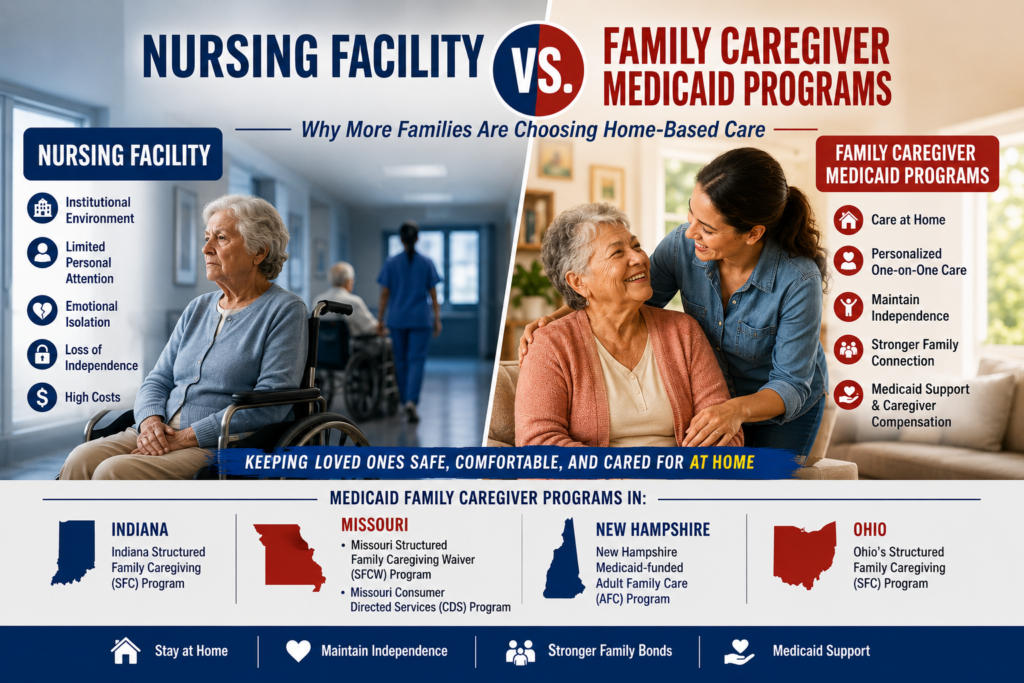
Why More Families in Indiana, Missouri, New Hampshire & Ohio Are Choosing Home-Based Care Instead of Nursing Homes
Across the United States, families are increasingly searching for alternatives to nursing facilities for seniors and adults with disabilities.
For many, the goal is simple:
Keep loved ones safe, comfortable, and cared for at home whenever possible.
That is why Medicaid-funded family caregiver programs are rapidly growing in states like:
- Indiana
- Missouri
- New Hampshire
- Ohio
Programs such as:
- Indiana Structured Family Caregiving (SFC) Program
- Missouri Structured Family Caregiving Waiver (SFCW) Program
- Missouri Consumer Directed Services (CDS) Program
- New Hampshire Adult Family Care (AFC) Program
- Ohio Structured Family Caregiving (SFC) Program
are helping families avoid unnecessary nursing facility placement by allowing loved ones to receive care in the comfort of home.
These programs support seniors and adults with disabilities through family-centered care while also providing caregiver support, care coordination, and Medicaid-funded assistance.
Today, more families are realizing that long-term care does not always have to mean moving into a nursing home.
The Growing Concerns Around Nursing Facilities
Nursing facilities remain important for individuals with severe medical conditions requiring continuous skilled nursing care. However, many families actively seek alternatives because of the emotional, financial, and quality-of-life concerns associated with institutional care.
Families often worry about:
- Emotional isolation
- Loss of independence
- Staffing shortages
- Limited one-on-one attention
- Unfamiliar environments
- Reduced family involvement
For seniors especially, leaving home can be emotionally overwhelming.
This growing concern is one reason Medicaid programs across multiple states are investing more heavily in home and community-based care programs.
Challenges Families Commonly Face With Nursing Facilities
1. Emotional Isolation and Loneliness
One of the most common concerns families report after nursing home placement is emotional decline.
Many seniors experience:
- Loneliness
- Depression
- Anxiety
- Reduced social engagement
- Emotional withdrawal
Moving from a familiar home into an institutional environment can be especially difficult for individuals with:
- Dementia
- Alzheimer’s disease
- Mobility limitations
- Cognitive decline
By comparison, home-based caregiver programs allow individuals to remain surrounded by:
- Family
- Familiar routines
- Personal belongings
- Community connections
2. Loss of Independence
Nursing facilities operate on structured schedules designed for many residents at once.
This can limit:
- Personal routines
- Flexibility
- Privacy
- Daily independence
Many seniors struggle emotionally after losing control over:
- Meal schedules
- Sleep schedules
- Social activities
- Household decisions
Home-based care programs help preserve independence while still providing essential daily support.
3. Staffing Shortages and Limited Personalized Attention
Families often express concern about staffing shortages in nursing facilities.
Common worries include:
- Delayed assistance
- High staff turnover
- Inconsistent caregiving
- Limited individualized attention
Even excellent facilities often require caregivers to divide attention among multiple residents.
Family caregiver Medicaid programs provide a more personalized approach where care is centered around one individual in a familiar environment.
4. Financial Pressure and Medicaid Spend-Down Requirements
Long-term nursing facility care is extremely expensive.
Families often face:
- Medicaid spend-down requirements
- Loss of savings
- Complex eligibility rules
- Financial stress
Many families are surprised to learn that Medicaid caregiver programs may allow loved ones to receive care at home while avoiding institutional placement.
Why Families Are Choosing Family Caregiver Medicaid Programs
Home-based Medicaid caregiver programs are becoming increasingly popular because they prioritize:
- Dignity
- Independence
- Emotional well-being
- Family involvement
- Personalized care
These programs allow eligible individuals to receive support from someone they already know and trust — often a family member or close friend.
For many families, this creates:
- Better emotional comfort
- Greater trust
- More consistent care
- Improved quality of life
Indiana Structured Family Caregiving (SFC) Program
The Indiana Structured Family Caregiving (SFC) Program helps seniors and adults with disabilities remain safely at home instead of entering a nursing facility.
Through this Medicaid-funded program:
- Family caregivers provide daily care and supervision
- Individuals receive support in a home setting
- Caregivers receive financial support and guidance
- Professional care teams help coordinate care
The program supports individuals who need help with Activities of Daily Living (ADLs), including:
- Bathing
- Dressing
- Meal preparation
- Medication reminders
- Mobility assistance
- Daily supervision
Many Indiana families choose SFC because it allows loved ones to stay in familiar surroundings while maintaining stronger emotional connections.
Missouri Structured Family Caregiving Waiver (SFCW) Program
Missouri’s Structured Family Caregiving Waiver (SFCW) Program helps individuals receive long-term care at home instead of moving into a nursing facility.
The program allows caregivers to support loved ones with:
- Daily personal care
- Safety monitoring
- Medication reminders
- Emotional companionship
- Household support
Families often prefer the SFCW program because it provides:
- More personalized care
- Greater independence
- Stronger family involvement
- Improved comfort at home
Missouri Consumer Directed Services (CDS) Program
The Missouri Consumer Directed Services (CDS) Program gives eligible individuals more control over their care by allowing them to choose their own caregiver.
This often includes:
- Family members
- Friends
- Trusted caregivers
The CDS program helps individuals maintain independence while receiving support with daily activities in their own home.
Compared to institutional care, CDS offers:
- Greater flexibility
- Familiar caregiving relationships
- Personalized support
- More control over daily routines
New Hampshire Adult Family Care (AFC) Program
New Hampshire’s Medicaid-funded Adult Family Care (AFC) Program provides an alternative to nursing home placement by allowing individuals to receive care in a family home environment.
The AFC program focuses on:
- Long-term home care support
- Family-centered caregiving
- Daily assistance with personal care
- Emotional and social support
Many New Hampshire families choose AFC because it helps loved ones remain connected to family life while avoiding institutional settings.
Ohio Structured Family Caregiving (SFC) Program
Ohio’s Structured Family Caregiving (SFC) Program supports caregivers who provide daily care to eligible seniors and adults with disabilities at home.
The program helps families avoid nursing facility placement while offering:
- Medicaid-funded support
- Caregiver guidance
- Ongoing monitoring
- Home-based long-term care services
Ohio families often prefer SFC because it allows loved ones to receive care from someone familiar while maintaining dignity and independence.
Nursing Facilities vs. Family Caregiver Medicaid Programs
| Nursing Facilities | Family Caregiver Medicaid Programs |
|---|---|
| Institutional environment | Care provided at home |
| Limited individualized attention | Personalized one-on-one care |
| Emotional isolation may occur | Stronger emotional connection |
| Structured facility schedules | Flexible home-based routines |
| Family becomes visitors | Family remains actively involved |
| Higher institutional costs | Medicaid-supported home care |
| Unfamiliar caregivers | Trusted caregiver relationships |
| Reduced independence | Greater dignity and independence |
Why Home-Based Care Is the Future of Long-Term Care
Families today want more than basic care services.
They want loved ones to experience:
- Comfort
- Independence
- Familiar surroundings
- Emotional support
- Family connection
Programs like:
- Indiana Structured Family Caregiving
- Missouri SFCW & CDS
- New Hampshire Adult Family Care
- Ohio Structured Family Caregiving
are helping families achieve these goals while avoiding unnecessary nursing facility placement.
Final Thoughts
Choosing between a nursing facility and a family caregiver Medicaid program is one of the most important decisions families can make.
While nursing facilities remain necessary for some complex medical situations, many seniors and adults with disabilities can safely remain at home with the right support system in place.
Family caregiver Medicaid programs provide a compassionate alternative that prioritizes:
- Personalized care
- Emotional well-being
- Independence
- Family involvement
- Quality of life
For many families, the best care is not found in an institution — it is found at home, surrounded by the people who matter most.